






































































































































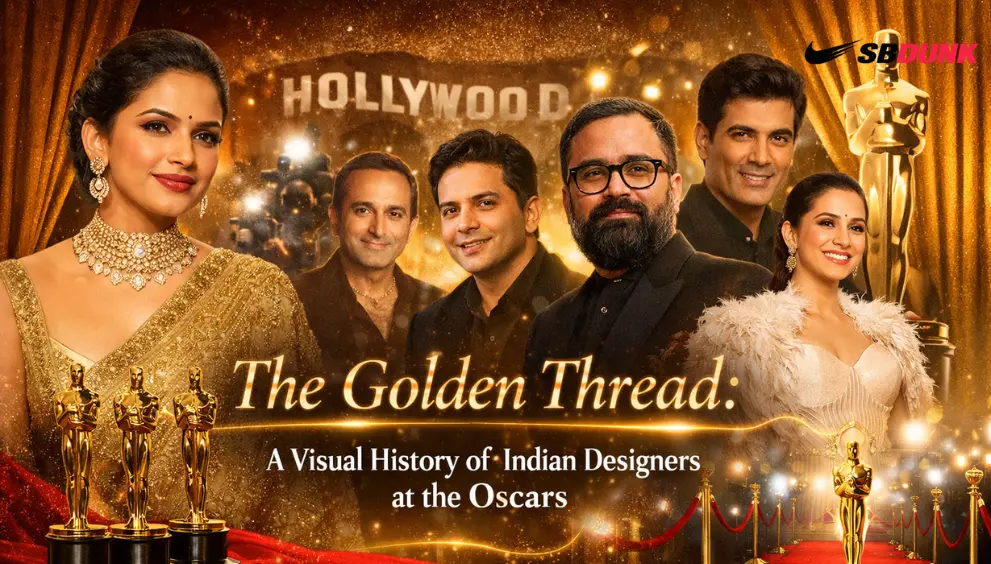
The Golden Thread: A Visual History of Indian Designers at the Oscars

For a long time, the Oscars’ red carpet felt like a closed loop. It was a sea of French silk and Italian tailoring, a beautiful but predictable parade of European luxury. If an Indian face appeared, the fashion choice was almost always a binary: you either wore a traditional saree to “represent your roots,” or you squeezed into a Dior archive piece to prove you belonged in Hollywood.
But looking back from the vantage point of 2026, something has shifted. It’s not just a trend; it’s a total tectonic move in how the world perceives Indian luxury brands. This is the story of the “Golden Thread” that connects a small village weaver to the bright lights of the Dolby Theatre.
1983: The Soul of a Saree
We have to start at the beginning with Bhanu Athaiya. When she walked up to accept her Oscar for Costume Design for Gandhi, she wasn’t wearing sequins or a ballgown. She wore a simple, hand-loomed cotton saree.
- The Statement: In a room full of 80s excess, think massive shoulder pads and perm-shampooed glamour. Bhanu looked like a quiet revolution.
- The Identity: She wasn’t trying to compete with Western silhouettes; she was bringing the literal fabric of India into the room.
- The Legacy: For decades after, the saree remained a “costume” to the Western press, something exotic rather than global couture. She planted the flag that proved we belonged in the room.
The 2010s: The “Fitting In” Era
Then came the gap. If you look at the 2010s, you’ll notice a pattern. Our biggest stars, Aishwarya, Priyanka, and Sonam, started showing up in Armani Privé, Elie Saab, and Ralph & Russo.
Here’s the thing: people often criticize this era for being “too Western,” but it was a necessary step. Our icons had to prove they could play the Hollywood game by Hollywood’s rules. They had to show they could carry a structured gown with the best of them.
- The Strategy: It was a period of assimilation.
- The Secret: While the labels were Western, the intricate beading and embroidery were often done in ateliers in Mumbai.
- The Face vs. The Hands: India was providing the labor, but not yet the brand name. We had to speak their language fluently before we could change the dictionary.
The 2020s: The Structural Explosion
Everything changed when we stopped trying to “fit in” and started trying to “stand out.” This was the rise of the New Guard, designers who treated fabric like architecture rather than just clothing.
Gaurav Gupta became the poster child for this shift. When his “Infinite” sculptures started appearing on the red carpet, the conversation changed. It wasn’t “Oh, that’s a pretty Indian dress.” It was “What on earth is that masterpiece, and how do I get it?”
Iconic Looks that Changed the Game:
- Megan Thee Stallion (2022): The “Fantasy Biomorph” gown. It looked like frozen water and proved Gupta could dominate a global stage.
- Li Jun Li (2026): The Sinners star wore a red sculpted satin corset gown called “Inner Flame.” It looked more like a 3D-printed cloud than silk.
- Rei Ami (2026): Wearing a Rahul Mishra “Nature’s Laboratory” cape, featuring hand-embroidered 3D butterflies that looked ready to fly off her shoulders.
- Rimzim Dadu: Even at the after-parties, her ruby metal corset gowns proved that Indian fashion is now synonymous with technical excellence.
The Jewelry Revolution
We can’t talk about 2026 without mentioning the “Sabyasachi Takeover.” For years, the Oscars were dominated by Harry Winston and Cartier. But this year, the “Sabyasachi High Jewellery” line became the ultimate status symbol.
- The Sabyasachi Takeover: Seeing Rachel McAdams and Ginnifer Goodwin in Sabyasachi’s heirloom-inspired gems, specifically uncut Polki diamonds and 10-carat emeralds, marked a total vibe shift.
- The Swadesh Initiative: This year, Swadesh (the artisanal luxury initiative) brought village-level craft to global icons. Law Roach and Brandi Carlile both sported handcrafted Swadesh brooches, highlighting Telangana goldsmith artistry.
- Zardozi & Resham: These aren’t just “ethnic” styles anymore. They are recognized as high-tier engineering feats, with a single gown requiring upwards of 5,000 human hours.
Craft over Identity: The Technical Soul
Why does “Made in India” now mean “technical excellence” rather than just “ethnic wear”? To understand that, you have to look at the emotional weight and the hours of labor poured into these garments.
- Zardozi (Metallic Thread Work): This isn’t just sewing; it’s an engineering feat. Using gold or silver-coated threads adds a weight and light-reflective quality that machines simply cannot replicate.
- Resham (Silk Embroidery): This is where the “painting” happens. In 2026, designers like Rahul Mishra use it to create 3D textures that look like hyper-realistic flora and fauna.
- The Human Hour: A single red-carpet gown often represents 3,000 to 5,000 hours of manual labor by artisans who have inherited these skills through generations.
The Final Verdict
We’ve moved from identity (wearing a saree because I’m Indian) to excellence (wearing an Indian designer because they are the best in the world).
In 1983, Bhanu Athaiya’s cotton saree was a whisper of Indian pride. In 2026, the structural, shimmering, bold designs of Gupta, Mishra, and Sabyasachi are a roar. We aren’t just “participating” in global fashion anymore. We are defining it.
The golden thread isn’t just a metaphor: it’s the literal stitch that has pulled India from the periphery of the red carpet to the very center of the spotlight. And let’s be honest: it’s about time.
FAQs:
1. Is the saree officially “out” at the Oscars?
Absolutely not. It’s just evolved. In 1983, it was a statement of “I am here.” In 2026, it’s a statement of “I am high-fashion.” We’re seeing more pre-draped, structural sarees that play with silk and metal. It’s not about tradition anymore; it’s about power.
2. What’s the deal with “Polki” diamonds?
They are uncut, raw diamonds. For years, the West wanted “perfect” machine-cut stones. Now, stars like Rachel McAdams want the “soul” of an heirloom. Polki looks ancient, heavy, and expensive. It’s the ultimate “quiet luxury” flex.
3. Who was the “Best Dressed” Indian designer this year?
It’s a toss-up between Li Jun Li in that red Gaurav Gupta “Inner Flame” gown and Rei Ami in Rahul Mishra’s butterfly cape. Both moved beyond “ethnic” and straight into “avant-garde.”
4. Is “Made in India” finally a premium label?
Yes. The 2026 Oscars proved it. When a star wears Rahul Mishra, they aren’t doing it for “diversity points.” They’re doing it because his hand-embroidery is technically superior to almost anything coming out of Europe right now.
5. How much work actually goes into these 2026 gowns?
A staggering amount. We’re talking 3,000 to 5,000 man-hours for a single couture piece. Most of that is specialized Zardozi (metal thread) or Resham (silk) work done by artisans whose families have been doing this for generations.